

Injury Patient Report – Knee Injury
Meniscal surgery is the #1 surgery performed by orthopedic surgeons in the US, according to the American Board of Orthopedic Surgeons. Knee injury, or more specifically, meniscal injury or a “torn meniscus,” can frequently be caused by a car accident, trauma, or slip and fall. Since the meniscus is subject to wear and tear, many patients can have asymptomatic meniscal tears that are made problematic by an accident.
In this edition of Utah OSIC: Injury Patient Report, we will focus on Meniscal tear injuries and go over:
1. Meniscal Injury
2. Meniscal Tears: Intro & Symptoms
3. Treatments: Meniscal Debridement and Meniscal Repair
“In our injury clinic, we frequently see meniscal injuries caused by accidents. While on occasion this injury can be treated non-operatively, surgery is usually required to get the patient back to activities and restore function.”
Dr. Phil Davidson
Co-Founder & Medical Director,
Board Certified Orthopedic Surgeon
Meniscal Injury
A patient who experiences trauma to the knee may experience a variety of symptoms ranging from mild to severe. Common symptoms that result from a meniscal injury include acute pain when rotating the knee, clicking, catching, locking, difficulty extending the knee fully, swelling and stiffness.
Immediate medical care is recommended if a patient cannot walk or move the knee in a usual fashion. This may represent entrapment, or locking, of the torn meniscal fragment. The sooner that is addressed, the better chance of saving the meniscus, which is protective of the joint.
Intro to Meniscal Tears
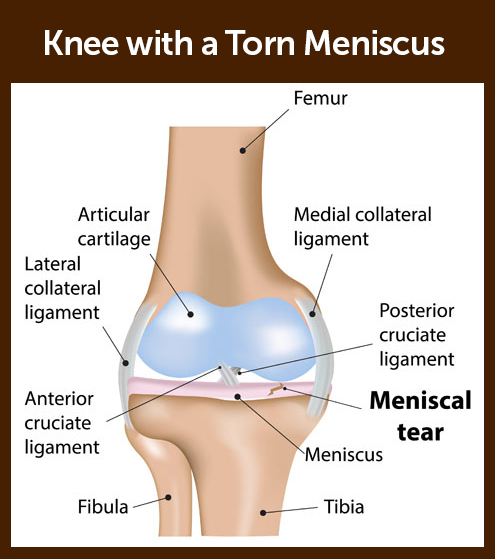 One of the most common knee injuries among athletes, injury victims, and active individuals is a “torn meniscus”.
Meniscal tears can result from a traumatic incident to the knee, such as a sports injury, slip and fall, or car accident. The meniscus is subject to wear and tear and aging, and adults can frequently tear with minimal trauma.
The pain of a torn meniscus typically manifests along the side or back of the knee and can be sharp and catching. The tearing can lead to chronic irritation and cartilage degradation if left untreated.
While some minor or small meniscus tears may heal on their own, many need surgical treatment. If surgery is necessary, the meniscus will either be trimmed or repaired, depending on the individual circumstance. If a patient is experiencing changes in mobility due to pain in the knee, evaluation for proper treatment is recommended.
A Further Look: Meniscal Debridement
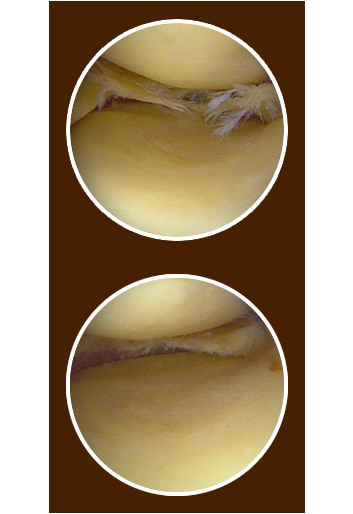 Meniscal debridement, or resection, is performed when the meniscus is not repairable. This is frequently the case.
Debridement, or ”clean up”, is an arthroscopic procedure in which the torn section of the meniscus is removed through small incisions, leaving behind the remaining healthy cartilage.
Following the debridement procedure, patients do not need to use crutches and can walk fully right away. Physical therapy is not typically necessary. Most patients can return to typical daily activities after a week and resume physical activities within 6-8 weeks.
A Further Look: Meniscal Repair
 Meniscal repair is an arthroscopic procedure that maintains the entire meniscus by suturing the torn meniscal tissue together.
While meniscal repair can be the best option under the right circumstances, the procedure will depend on the individual circumstance, and the recovery time is longer than resection. The advantage of repair is that the repaired meniscus can protect the knee.
Crutches, bracing and physical therapy are used postoperatively. It takes about four months to get back to full speed.
Medical Specialists Providing Coordinated Care
We work as a physician-led team of specialists to provide the most comprehensive and complete recovery from injuries. We provide services ranging from immediate injury evaluation to complex sub-specialty surgical treatments. We provide both diagnostic and treatment services. We can arrange testing to include: MRI, CT scan, EMG, ultrasound, neurologic testing, and digital x-ray, among other necessary modalities. Our expertise is in both non-surgical and surgical care.
We provide complete surgical services, including surgical facility, anesthesia and implants. The care rendered in our clinic and our affiliated facilities is medically supervised to assure the best outcomes.
When Should I Refer A Patient to OSIC?
Early! We can provide comprehensive and coordinated care most effectively soon after the injury. Once a patient is out of the Emergency Room, or Urgent Care is the perfect time to send them to OSIC. We are also available to evaluate patients further out from the accident.
What Types of Injuries Do You Treat?
We treat both relatively minor and major complex injuries. We treat all bodily injuries and traumatic brain injuries. We have specialists in neurosurgery, neurology, spine, shoulder, elbow, hand/wrist, hip, knee, foot/ankle, physiatry, pain management, interventional spine, psychology, brain injury care, neuro-optometry, nutrition, life care planning and neuropsychology. When needed, we provide additional support care, including medical, cardiac, pulmonary, radiological, and infectious disease, among others.